
Some holidays are about seeing as much as possible. Meghalaya is better when you do the opposite.
Here, a bend in the road can suddenly open into a valley. Clouds can descend over the hills while you are still deciding where to stop for tea. A waterfall you planned to photograph may make you stay for an hour. And a lake that was supposed to be a quick stop on the way to Shillong may convince you not to leave just yet.
That is the first rule of planning the perfect Meghalaya trip: do not rush it.
From the blue-green expanse of Umiam to the rain-shaped landscapes of Sohra, the crystal-clear waters around Dawki and the forested world of the Garo Hills, Meghalaya deserves a journey that leaves room for discovery.
So, before searching for the best places to stay in Meghalaya, start with the more important question: what kind of Meghalaya do you want to experience?
First, decide how many days Meghalaya deserves
Technically, you can see some of Meghalaya in three or four days. But seeing Meghalaya and experiencing it are two very different things.
For a first visit, six to seven days gives you enough time to explore Shillong, Umiam, Sohra and the Dawki–Mawlynnong belt without turning every morning into a race to the next destination. Meghalaya Tourism itself recommends itineraries ranging from short three-day journeys to broader five and seven-day circuits.
If you want to go beyond the familiar tourist circuit and explore landscapes around the Garo Hills and Sakal Aduma, consider eight to ten days.
The trick is to choose your accommodation in Meghalaya according to your route instead of staying in one city and spending half your holiday driving back and forth.

When should you visit Meghalaya?
There is no single correct answer because Meghalaya changes character with the seasons.
From October to April, the generally drier weather makes walking, trekking and outdoor exploration easier. The monsoon months from May to September, on the other hand, transform the landscape, filling waterfalls and wrapping the hills in rain and mist.
So choose according to what you want.
Come in the drier months if you imagine clear views, long drives, treks and slow outdoor days. Come during the rains if waterfalls, mist and intensely green landscapes are the reason Meghalaya is on your list in the first place.
Just remember that heavy rain can affect road conditions and outdoor plans. Meghalaya Tourism recommends checking weather forecasts during the monsoon and carrying waterproof gear and anti-slip footwear.

Day 1: Do not drive past Umiam. Stay.
For most travellers arriving via Assam, the journey begins at Guwahati. Guwahati Airport is the main aviation gateway and lies roughly 100 km from Shillong, while Shillong Airport at Umroi is closer but has more limited connectivity.
And before you reach Shillong, Meghalaya gives you quite an introduction.
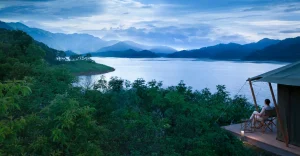
Umiam Lake appears between forested hills along the Guwahati–Shillong route, approximately 15 km from Shillong. Created after the Umiam River was dammed for a hydroelectric project in the 1960s, it has since become one of the region’s best-known scenic and recreational spots, with boating and water activities among its attractions.
This is why travellers looking for places to stay near Shillong should consider stopping here rather than heading straight into the city.
Searches for resorts near Umiam Lake, a resort near Umiam Lake, or resorts near Barapani all lead back to the same idea: make the lake part of your stay, not merely something you photograph from the highway.
Umiam is also widely known as Barapani, so travellers may come across terms such as Barapani Lake resort or resort at Barapani Shillong while planning.
But forget the search terms once you arrive. Take the evening slowly. Watch the changing light over the water. Let your first day feel like an arrival rather than another sightseeing schedule.
Day 2: Meet Shillong beyond the checklist
Shillong deserves more than a hurried stop at Police Bazaar.
The capital moves between very different moods: pine-filled neighbourhoods, busy commercial streets, cafés, cultural spaces and viewpoints. Meghalaya Tourism highlights its mix of quiet neighbourhoods, downtown energy and café culture, while places such as the Don Bosco Museum offer a deeper introduction to the heritage of Northeast India.
Spend the day walking, eating and looking around without trying to tick off ten attractions.
If you prefer being in the middle of the city’s activity, accommodation in Shillong makes sense. If you would rather wake up closer to water and hills while remaining within reach of the capital, Umiam can be a more atmospheric alternative.
This is what makes choosing among the many places to stay in Meghalaya important. The right location can change the rhythm of the entire trip.

Day 3: Take the road towards Sohra
The approximately 55-km journey from Shillong to Sohra, historically known as Cherrapunji, takes you deeper into the East Khasi Hills. The region is shaped by cliffs, caves, waterfalls and extraordinary rainfall, with attractions including Nohkalikai Falls, Dainthlen Falls, Mawsmai Cave and Arwah Cave.
And this is one place where staying overnight matters.
Many travellers planning a stay in Cherrapunji try to fit Sohra into a day trip from Shillong. You can, but you lose something in the process.
When you search for the best place to stay in Cherrapunji or browse resorts in Cherrapunji Meghalaya, think beyond room categories. Choose based on what gives you time to experience the landscape when the day visitors have left.
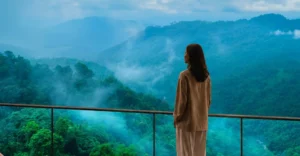
Spend an evening listening to rain if you are travelling during the monsoon. Wake up early for the viewpoints. Give yourself enough time for a cave, a waterfall or a longer walk instead of attempting all three before lunch.
In Meghalaya, less often becomes more.
Day 4: Root bridges, villages and rivers
The next day can take you towards Mawlynnong and Dawki–Shnongpdeng.
Mawlynnong is known for its carefully maintained village landscape and the nearby Nohwet Living Root Bridge, created by guiding the living roots of Ficus elastica over generations. It lies around 76 km from Shillong.
Farther towards the India–Bangladesh border, Dawki and Shnongpdeng bring another change in scenery. The Umngot River is renowned for its clear waters, with boating and other river-based experiences among the area’s major draws.
Do not plan this section purely according to Instagram stops. Leave time for the road itself, local meals, short pauses and conversations along the way.
They are often the parts of a Meghalaya trip you remember longest.

Then, go beyond the Meghalaya everyone already knows
Shillong, Sohra and Dawki make a wonderful first journey.
But they are not the whole story.
Jongksha in the East Khasi Hills presents another opportunity to slow the pace. For travellers searching for accommodation in Jongksha, the appeal lies precisely in stepping away from a conventional city-based itinerary. Meghalaya’s tourism plans have identified Jongksha–Umkhoi as a hospitality and tourism destination within East Khasi Hills.
And if you have more days, turn west towards the Garo Hills.
This is where Sakal Aduma changes the scale of the journey.
Situated beside the wider Nokrek landscape in West Garo Hills, Sakal Aduma sits within a region known for forest, biodiversity and dramatically different terrain from the Khasi Hills. Government tourism projects have identified Sakal Aduma as a location for eco-tourism development near Nokrek.
For travellers researching a resort in Sakal Aduma Meghalaya, places to stay in Sakal Aduma, or accommodation in Sakal Aduma, this is not simply another overnight stop. It offers a way to experience a side of Meghalaya that many shorter itineraries never reach.
If your idea of a holiday involves forest mornings and destinations that still feel removed from the familiar circuit, extending your stay in Sakal Aduma can become one of the most distinctive parts of the journey.

Choose a stay that belongs to the landscape
The best resort in Meghalaya is not necessarily the one with the longest amenity list.
It is the one that makes sense for the Meghalaya you have travelled all this way to experience.
A lakeside stay should let you feel the lake. A hill stay should make mornings worth waking early for. A forest stay should make you want to put your phone away.
That is also the idea behind Living Meghalaya, with experiences across Umiam, Jongksha and Sakal A·duma. Instead of treating accommodation in Meghalaya as simply a room between sightseeing stops, each location can become part of how you encounter the state itself.
Because the perfect Meghalaya trip is not really about fitting more into the itinerary.
It is about giving each place enough time to become a memory.
Come for the waterfalls and root bridges. Stay for the quiet roads, the changing skies, the forests, the lake at dusk and those unexpected moments between one planned destination and the next.
After all, Meghalaya is a beauty meant to be lived. Tell us when you would like to come.